Scroll-Drawn Journey Path — Multi-Stage Roadmap Lesson
A long lesson where a curving path draws down the page on scroll and milestones reveal alongside it — pilots a sober-recovery roadmap but the pattern fits any 5–7 stage journey where the metaphor IS the layout.
Best for: Roadmap-style lessons structured as a 5–7 stage journey with predictable shape — recovery arcs, behavior-change programs, career pivots, transformation stories, language learning, or any 'what will the next 3–12 months actually feel like' content.
Live preview — scroll inside the frame to see the full page.
What it does
- Scroll-drawn path — a faint dashed path is visible on load; an active colored path draws itself in as the learner scrolls
- Activating milestone markers — each marker fills, scales up, and gains a soft shadow as the learner reaches its point on the path
- Per-milestone teaching card — each card fades in and slides up alongside its milestone with a headline, two paragraphs, and a focus box
- Alternating left/right layout — cards alternate sides along the meandering curve on desktop, collapsing to a single column on mobile
- Honest cost block — a 'what this journey will cost you' reflection block names the actual cost of the work in plain language
- Closing CTA card — closes with a 'begin lesson 02' card and a small press feedback for tactile finish
Best use cases
- Recovery and behavior change — sobriety arcs, eating-disorder recovery, smoking cessation, gambling recovery
- Mental health teaching — stages of grief, the arc of postpartum, the shape of burnout recovery
- Career and professional transitions — six stages of leaving an industry, the founder's first year
- Fitness and physical transformation — 12-week strength arcs, postpartum return, race-prep cycles
- Spiritual and contemplative practice — naming the shape of the work as part of the work
- Creative-practice journeys — first novel, year of daily painting, language-learning fluency arc
What you can change with your DNA
When you run this through the remix skill, your CCOS DNA — brand, voice, audience — drives these decisions automatically:
- Colors — six slots: page background, paper, ink, soft ink, journey-path color, and a sparingly used accent. Swap whole-palette per niche (pale blue + navy + amber for fitness, pale rose + plum + gold for relationship work)
- Fonts — two roles: a display serif with italic personality for headlines, and a clean body sans for paragraphs
- Copy — opener, journey title, six milestones (label, headline with italic, two paragraphs, focus box), reflection block, closing CTA. The reflection block is non-negotiable — it's what separates this from a happy-path roadmap
- Images — none required; the path is the only graphic. Markers can swap to icons, emoji, or symbols if numbers don't fit the niche
- Behavior — path geometry (S-curve, climb, descent, spiral, zigzag), number of milestones (five to seven), draw speed, and milestone enter trigger
How remixing works
From "swiped it" to "shipped it" in three steps.
Pick a remix
Browse the library, find one that fits — like this one.
Run it through your DNA
The remix skill uses your CCOS DNA to swap colors, fonts, copy, and structure so it lands as yours.
Ship it
Paste the finished HTML into Thinkific, Kajabi, WordPress, or any platform that takes embed code.
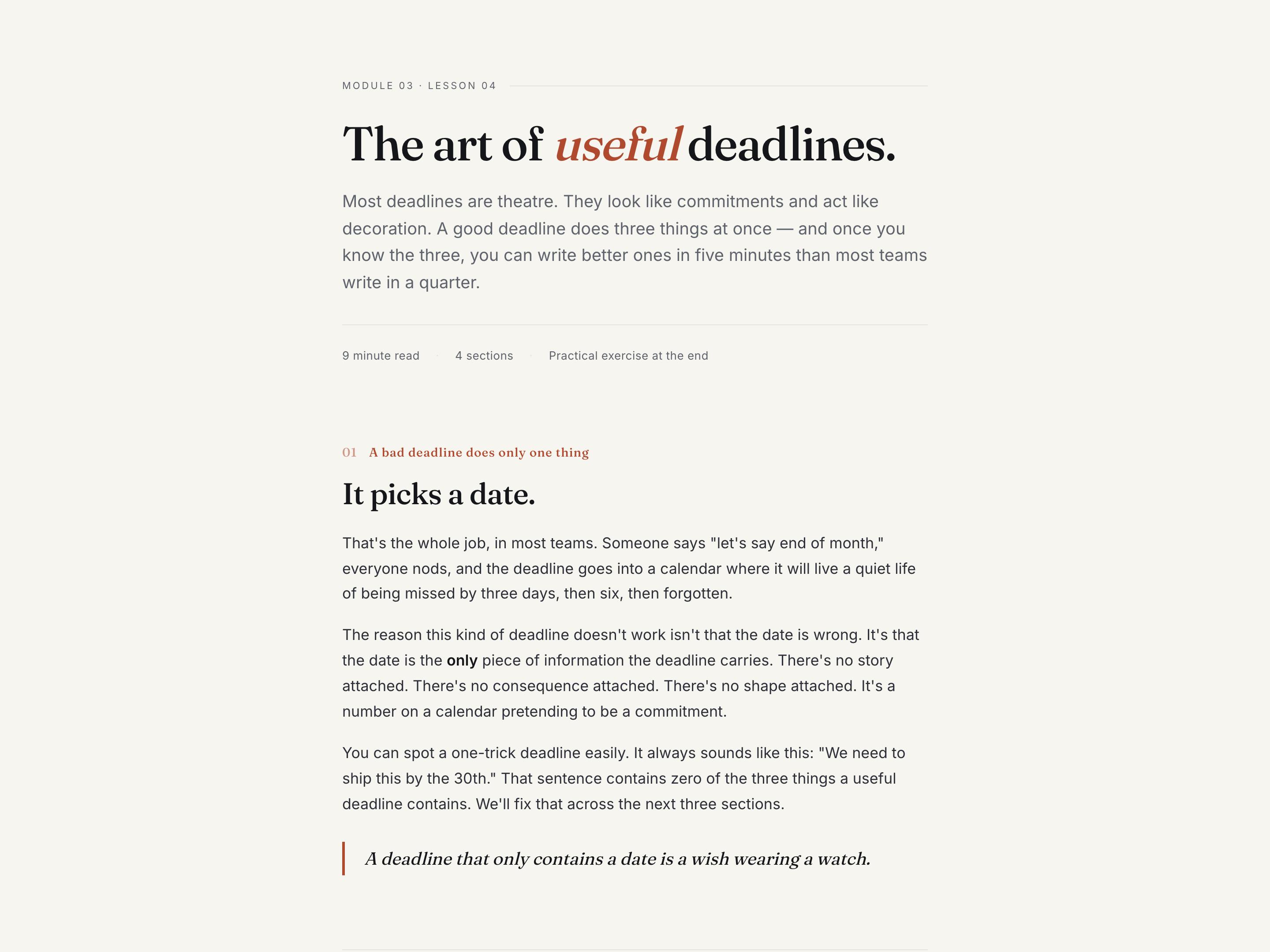
Scroll Progress Bar — Long-Form Lesson Wayfinding Variant
A fixed-top reading progress bar with hover-revealed jump-to-section markers that fills only across the lesson body — not the header — so 100% means the learner actually finished the teaching. Pilots a long-form essay but the pattern fits any lesson, sales page, or article over five minutes.

Welcoming Words Loader — Ambient Lesson Entry
A lesson-entry overlay that cycles through a few italic-serif greeting words against a drifting mesh-gradient field, then fades to reveal the lesson — pilots an ambient welcome but the pattern fits any course where setting an emotional temperature matters as much as the content.
Create a new list
Save your favorites
Email me a magic link and I'll add this to your favorites list.